

Sparse long-term, low-cost monitoring
/Watching the Invisible: How a Small Norwegian Test Site Could Help Unlock Gigaton-Scale CO₂ Storage
Svelvik, Norway – Standing on the shore of the Drammensfjord, it is difficult to imagine that this quiet corner of Norway could play a role in one of the world's biggest climate challenges.
There are no towering industrial facilities here. No pipelines stretching to the horizon. No giant machines. Instead, visitors arriving at the Svelvik CO₂ Field Lab are met by a surprisingly modest research site built on a large sand deposit beside the fjord.
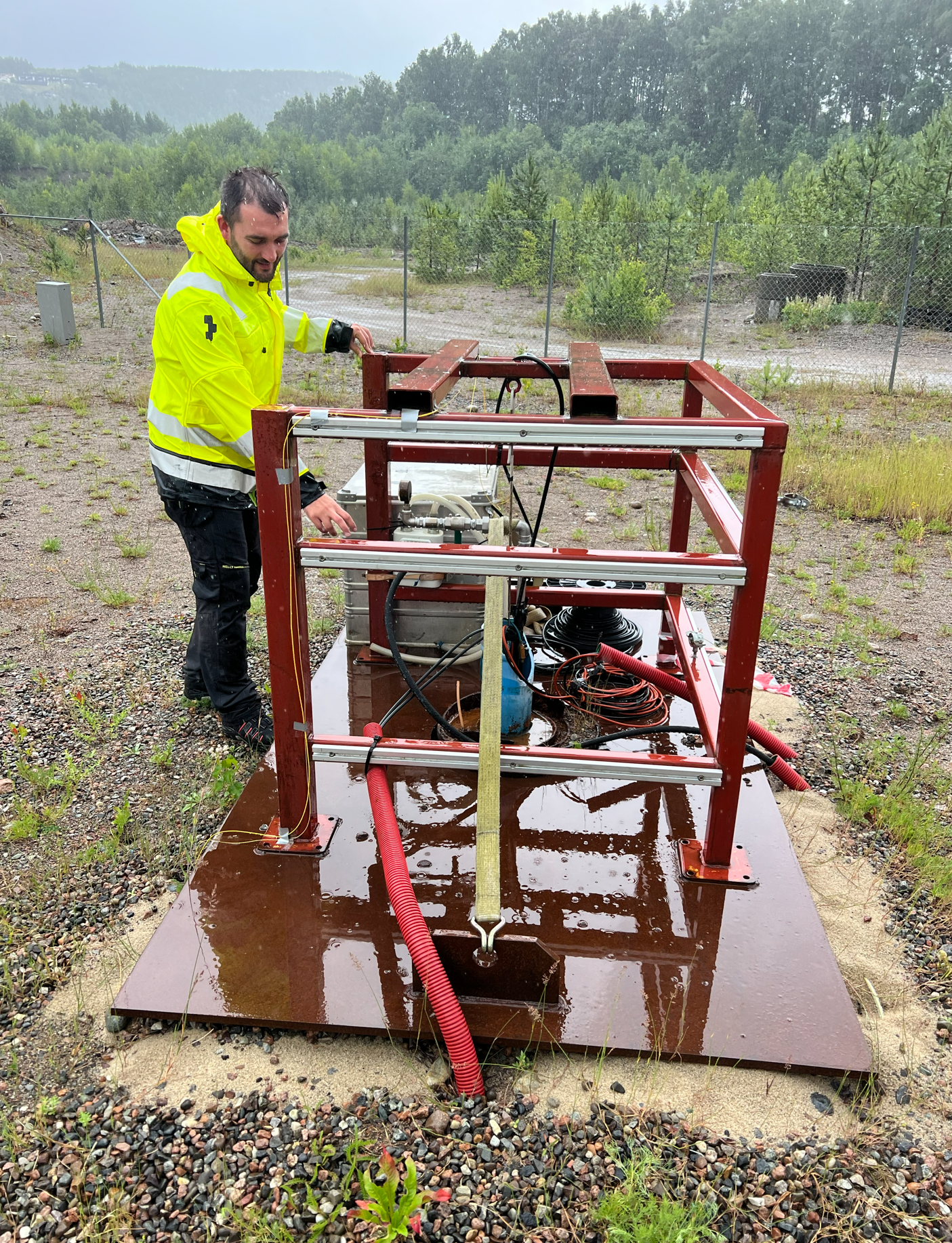
Research scientist Marcin Duda explains how the CO2 injection modul works. Photo: Aage Stangeland
Yet the work being carried out here could help solve a critical problem for the future of carbon capture and storage (CCS): how to monitor enormous underground CO₂ reservoirs without spending a fortune.
Researchers in the international SPARSE project believe they may have found part of the answer. CCS is viewed as an important technology for industries where CO2 emissions are difficult to eliminate. The concept is to capture CO2 before it reaches the atmosphere and store it deep underground in suitable geological formations. One challenge is that CO2 storage operators must demonstrate that the CO₂ remains safely contained for decades.
That is where monitoring comes in.
It is predicted that billions of tons of CO2 could be stored globally. According to the SPARSE team, one billion ton of CO₂ could be stored within an underground area roughly 75 kilometres across. Monitoring such vast reservoirs using conventional methods can become expensive.
The SPARSE project started with a simple question: What if you could monitor a giant underground storage site using far fewer sensors?
Rather than deploying large numbers of instruments across the entire reservoir, the researchers developed a concept based on strategically positioned monitoring nodes that continuously collect information. These nodes combine several measurement techniques, including seismic monitoring, electromagnetics, gravity measurements and observations of surface deformation. By integrating these data streams, researchers can track the movement of CO₂ while keeping the number of sensors to a minimum.
Developing such a system requires a combination of advanced science and practical engineering.
The project has included extensive modelling of CO₂ storage, testing of monitoring strategies, and field experiments. The researchers have evaluated how different sensor types respond to changes underground and how data from multiple sources can be combined to maximize information while minimizing cost. Field testing has also been conducted in Canada, helping researchers assess practical deployment options and data quality under real-world conditions.
The atmosphere at Svelvik reflects the project's philosophy. Rather than building large and expensive demonstration facilities, researchers use a compact and cost-effective test environment where new concepts can be evaluated quickly. At a recent project meeting it was commented that the site is almost "underwhelming" at first sight. But that is precisely its strength. Groundbreaking technology does not always emerge from grand laboratories; sometimes it starts with carefully designed experiments in surprisingly ordinary surroundings.
The project has now reached an important milestone. The core SPARSE concept has been successfully demonstrated through modelling and testing, showing that sparse monitoring can provide meaningful information about the development and containment of stored CO₂.
The story does not end there.
Shortly before the Svelvik meeting, the consortium received funding for SPARSE2, a follow-up project that will move the technology closer to industrial deployment. The new project will test key monitoring components in the Trondheim Fjord, involve industry partners and service providers, and further develop the concept for future commercial CO₂ storage operations. The Trudvang CO₂ storage licence in Norway will serve as an important case study for designing next-generation monitoring systems.
For a world seeking practical ways to reduce greenhouse-gas emissions, this may prove significant.
Large-scale CCS will require not only the ability to store CO₂ safely, but also the ability to prove it. By showing that reliable monitoring can potentially be achieved with fewer sensors and lower costs, SPARSE is helping address one of the barriers to widespread deployment.
The equipment at Svelvik may be small. But the ambition is anything but small. If the SPARSE vision succeeds, technology developed on the shores of a Norwegian fjord could one day help monitor CO₂ storage projects measured not in thousands, but in billions of tons.
The SPARSE journey also illustrates the value of international research cooperation. The original project was funded through Accelerating CCS Technologies (ACT), a multinational initiative established to accelerate the development of cost-effective carbon capture and storage technologies. Building on the success of SPARSE, the consortium recently secured funding for SPARSE2 through the Clean Energy Transition Partnership (CETP), one of Europe's largest collaborative programs for clean energy research and innovation. The work also benefits from the unique facilities and expertise available through ECCSEL, the European Research Infrastructure for Carbon Capture, Utilisation and Storage, which provides researchers with access to specialized CCS laboratories and test sites across Europe. Together, ACT, CETP and ECCSEL demonstrate how international collaboration can help transform promising research concepts into technologies ready for real-world deployment.
